

Paperless Factory: When Paper Is Replaced by E-Labels, Data and Smart Software
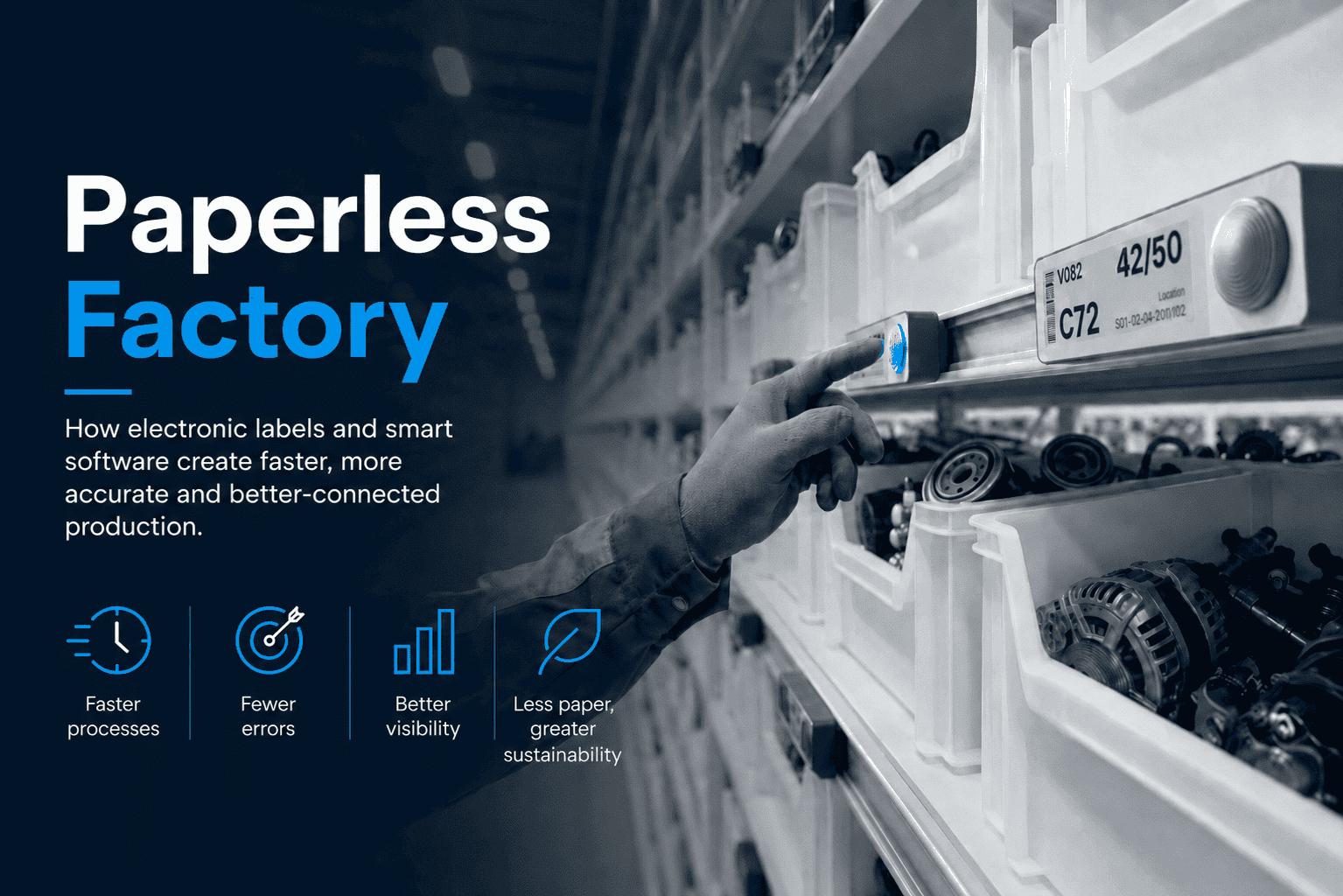

by Luka Žvar
When we talk about a paperless factory, the first thing that often comes to mind is reducing paper consumption: fewer work orders, fewer printed lists, fewer labels and less manual data entry. This is an important part of the story, but it is far from the whole picture.
The true value of a paperless factory lies in transferring information directly from business systems to the production floor or logistics site — quickly, clearly and without intermediate manual steps. Workers no longer need to search for the latest version of a document, check whether a list is still up to date or enter information back into the system manually. Instead, they receive the right information in the right place, confirm tasks digitally, and the system records every change in real time.
This approach is the foundation of smart manufacturing. As NIST highlights in its definition of smart manufacturing, it is based on connected systems that can respond quickly to changes in production, the supply chain and customer demand.
What Is Slowing Down Your Factory?
Many production and logistics environments still rely on a combination of paper-based work orders, printed lists, labels, manual checks and the subsequent entry of data into ERP, WMS or MES systems.
At first glance, this way of working may seem simple. In practice, however, it creates several hidden costs:
- printing and distributing documents,
- manually checking products, locations, quantities or batches,
- delays caused by changes to orders or production plans,
- errors when manually entering data,
- lost or outdated work orders,
- additional checks and repeated work,
- limited visibility into what is happening on the production floor or in the warehouse at any given moment.
Every change made in the system must reach the people on the shop floor. When that information is communicated on paper, there is always a delay. When it is delivered digitally, however, a workstation, shelf, container, production line or machine can display the new information immediately.
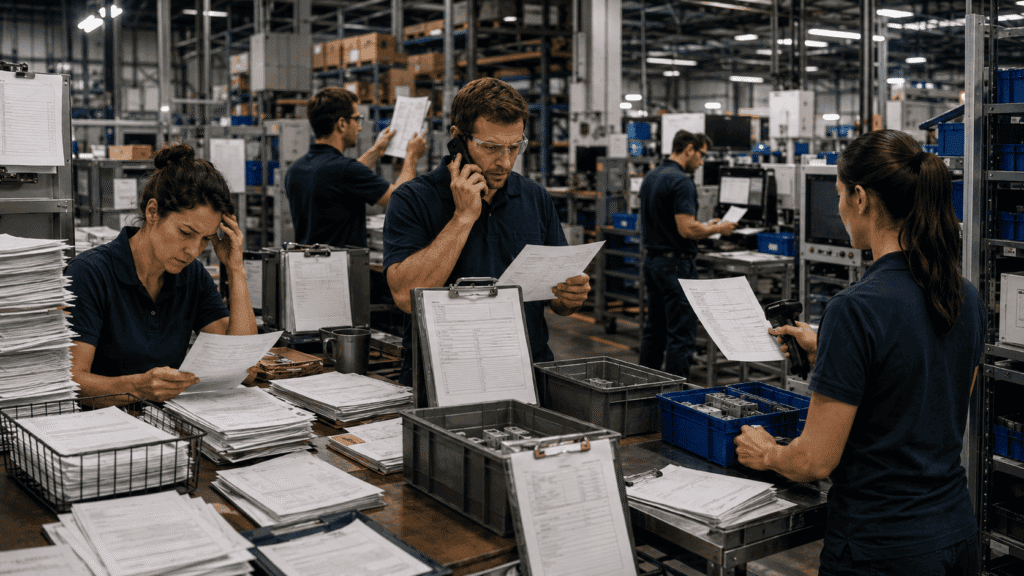
Image: A cartoon of a “paper-overloaded” factory
How Does a Paperless Factory Work?
A paperless factory connects the physical world of production with a company’s digital systems. In practice, this means that data from an ERP, WMS, MES or another business application is displayed directly where the work is carried out. Electronic labels, or ESL displays, play an important role in this process. Although many people are familiar with them mainly from retail environments, they are also extremely useful in industrial settings. You can learn more about these solutions on the Positiva – Electronic Shelf Labels page.
In production, electronic labels can display information about products, locations, work orders, quantities, batches, statuses, alerts, QR codes or work instructions.
In production and logistics, such a system could work as follows:
- The system receives an order or production order.
- The software identifies which locations, materials or containers are involved in the process.
- The electronic label at the location displays the relevant information.
- An LED indicator guides the worker to the correct location.
- The worker completes the task and confirms it by pressing a button, scanning a code or performing another digital action.
- The information is sent back to the system, where it is immediately available for the next steps.
In this way, paper does not disappear merely for aesthetic or environmental reasons. It disappears because it is no longer needed in a process driven by live data.
Electronic Labels as Industrial Displays
Electronic labels are no longer merely digital price tags on store shelves. In industrial environments, they become small, energy-efficient information displays installed on shelves, containers, workstations, transport units or machines.
Their main advantages are excellent readability, extremely low energy consumption and centrally managed content updates. This means that a company can update the information displayed at hundreds or even thousands of locations without printing, physically replacing labels or requiring employees to make additional rounds.
In industrial environments, electronic labels can display:
- product codes,
- material names,
- quantities to be picked,
- locations,
- serial or lot numbers,
- order statuses,
- alerts,
- QR codes,
- instructions for the next step,
- stock information,
- confirmation statuses.
Combined with LED indicators and buttons, electronic labels can also support pick-by-light processes. Instead of searching for a location using a printed list, the worker is guided to the correct place by a light signal. Once the task is completed, the worker presses a button and the system receives confirmation.
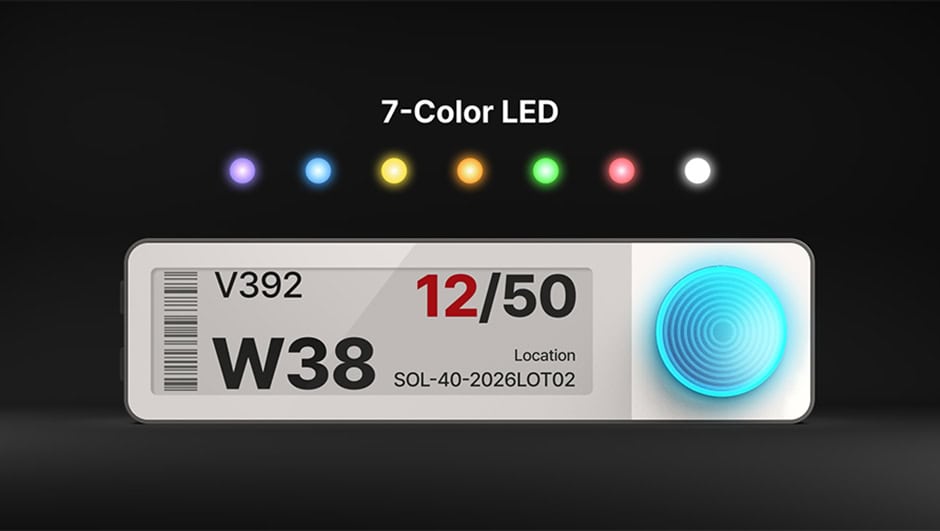
Image: SoluM Newton Industrial electronic label
Fewer Errors in Picking and Production Supply
One of the greatest advantages of a paperless factory is the reduction of errors in manual processes. When employees have to find locations themselves, compare information on paper, check quantities and then manually confirm task completion, the risk of error is significantly higher. In a digital process, instructions are clearly displayed at the relevant location. If the system uses LED guidance, the physical location is highlighted as well.
When digital confirmation is also included, every step can be recorded immediately. This is particularly important in environments with large numbers of different products, locations and batches, or where orders change frequently.
Typical applications include:
- material picking,
- supplying assembly lines,
- container labelling,
- shelf and rack labelling,
- shipment preparation,
- internal logistics flows,
- high-mix production,
- process checkpoints,
- digital Kanban.
In such processes, speed is not the only objective. Equally important are accuracy, traceability and the ability of production or logistics managers to see the actual operational status without delay.
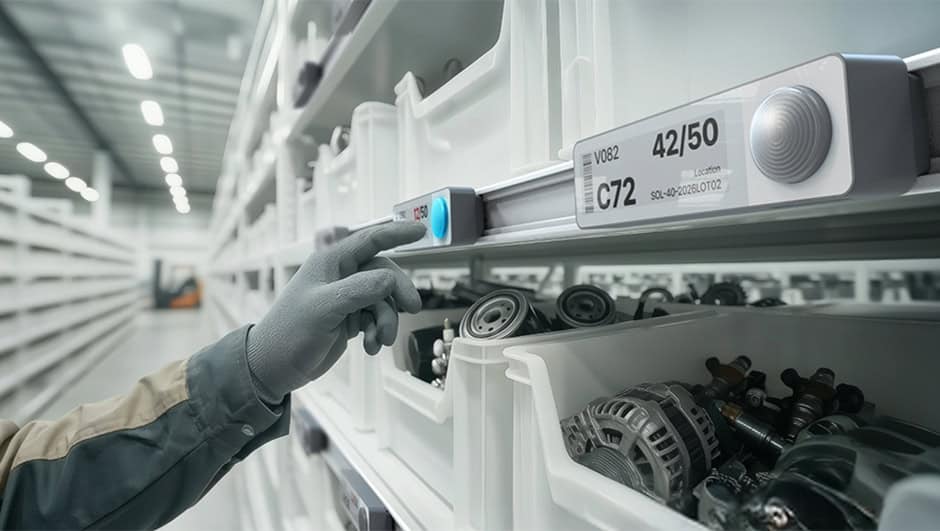
Image: Electronic labels in production
Software Is the Heart of a Paperless Factory
Hardware is the visible part of the solution. Electronic labels, LED indicators, buttons, scanners and access points are the components employees use on the shop floor. However, the true value emerges only when everything is connected through software. Without effective software integration, an electronic label merely displays information. With effective integration, it becomes part of the business process.
At Positiva, we take a comprehensive approach to the paperless factory. It is not simply about supplying displays, but about connecting devices, data and processes. We develop software solutions that can be integrated with a company’s existing systems, such as ERP, WMS, MES, PIM or other internal applications.
This approach enables:
- centralised management of content displayed on electronic labels,
- automatic data updates from business systems,
- customised displays for different workstations,
- integration with warehouse and production processes,
- confirmation of completed tasks,
- real-time status updates,
- reports and dashboards,
- the development of additional custom features.
Every production environment is different. It is therefore important that the solution is not implemented as a closed system, but as a flexible platform that supports the company’s actual processes.
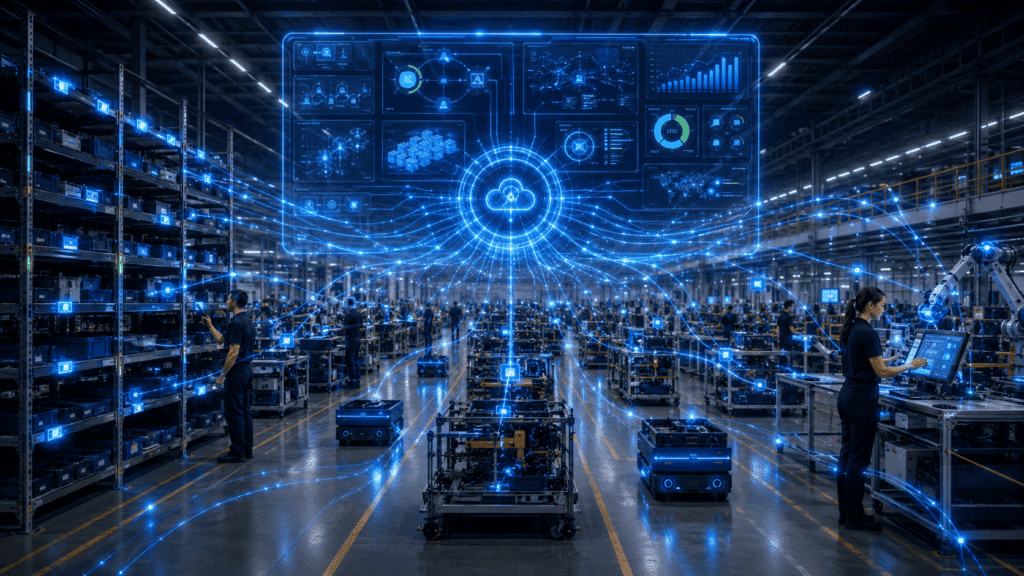
Image: Software is the heart of a paperless factory
Why Is a Paperless Factory Important for Competitiveness?
The digitalisation of production is no longer reserved for the largest industrial operations. Medium-sized companies also face challenges such as labour shortages, demands for shorter delivery times, greater traceability, higher customer expectations and the need to adapt more quickly to change. A paperless factory helps address these challenges by giving companies greater control over how work is carried out.
The main benefits of a paperless factory include:
1. Faster information updates: When an order, quantity, location or priority changes, the information is updated digitally. There is no need to reprint and redistribute documents.
2. Less manual work: Employees spend less time searching for information, checking details, entering data and confirming tasks on paper.
3. Fewer errors: Clear instructions, LED guidance and digital confirmation reduce the risk of picking the wrong item, selecting the wrong quantity or going to the wrong location.
4. Greater traceability: The company can track more precisely what was completed, when and where it was done, and its current status.
5. Better process visibility: Managers can monitor operations in real time, identify bottlenecks more quickly and make data-driven decisions.
6. Less paper and less waste: Less printing means lower costs, less document-related handling and more sustainable business operations.
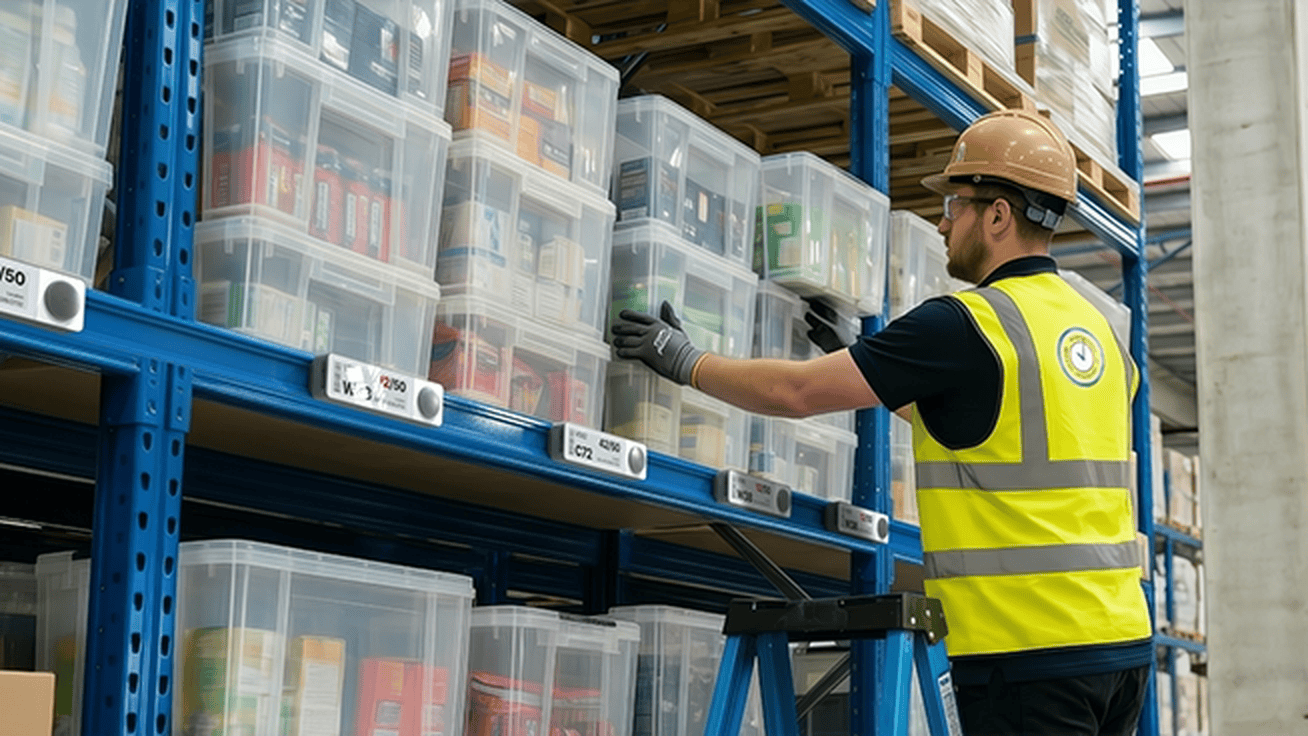
Image: Pilot project for implementing electronic labels in industrial processes
Positiva as Your Paperless Factory Partner
At Positiva, we combine expertise in electronic labels, software development and business system integration. This enables us to support companies throughout the entire journey — from selecting the right electronic displays to developing application logic, integrating existing systems and tailoring the solution to specific production or logistics processes.
Our goal is not simply to digitise paper. It is to simplify work, reduce errors and create a system that helps employees perform their tasks while giving management greater visibility into operations.
A paperless factory is not a distant vision that is still years away. It is an upgrade that companies can introduce gradually — starting with a single process, production line, warehouse or type of workstation.
When data from business systems is connected with physical work on the production floor, paper becomes unnecessary. That is when true digitalisation begins.
Would You Like to Find Out Where Paper Can Be Replaced with a Digital Process?
If you still use paper-based work orders, lists, labels or manual confirmations in production, warehousing or logistics, this could be the ideal starting point for your first step towards a paperless factory.
At Positiva, we can help you analyse your processes, select the right electronic labels and develop a software solution that integrates with your existing systems.
Contact us and let’s explore where digitalisation can deliver measurable results most quickly.
Recommended Posts
Positiva received the WEBSI award for the redesign of the Telekom.si website
16. September, 2024
The use of electronic shelf labels in the industry
18. August, 2023